Effective Prompts
What you'll learn
- Understand what prompt engineering is and why it matters for productive AI collaboration
- Apply six foundational prompting techniques to improve your AI interactions
- Identify common patterns that lead to successful AI interactions
- Troubleshoot and refine prompts when AI responses don't meet your needs
Key takeaways
- Effective prompting combines clear communication principles with AI-specific techniques.
- Six foundational prompting techniques:
- Give context: Be specific about what you want, why you want it, and relevant background
- Show examples: Demonstrate the output style or format you're looking for
- Specify constraints: Clearly define format, length, and other output requirements
- Break complex tasks into steps: Guide the AI through multi-step reasoning
- Ask the AI to think first: Give space for the AI to work through its process
- Define the AI's role or tone: Specify how you want the AI to communicate
- The "secret weapon": Ask the AI itself to help improve your prompt.
Use other AI models to write prompts - Successful prompting is iterative (and often collaborative with the AI). Expect to refine based on results
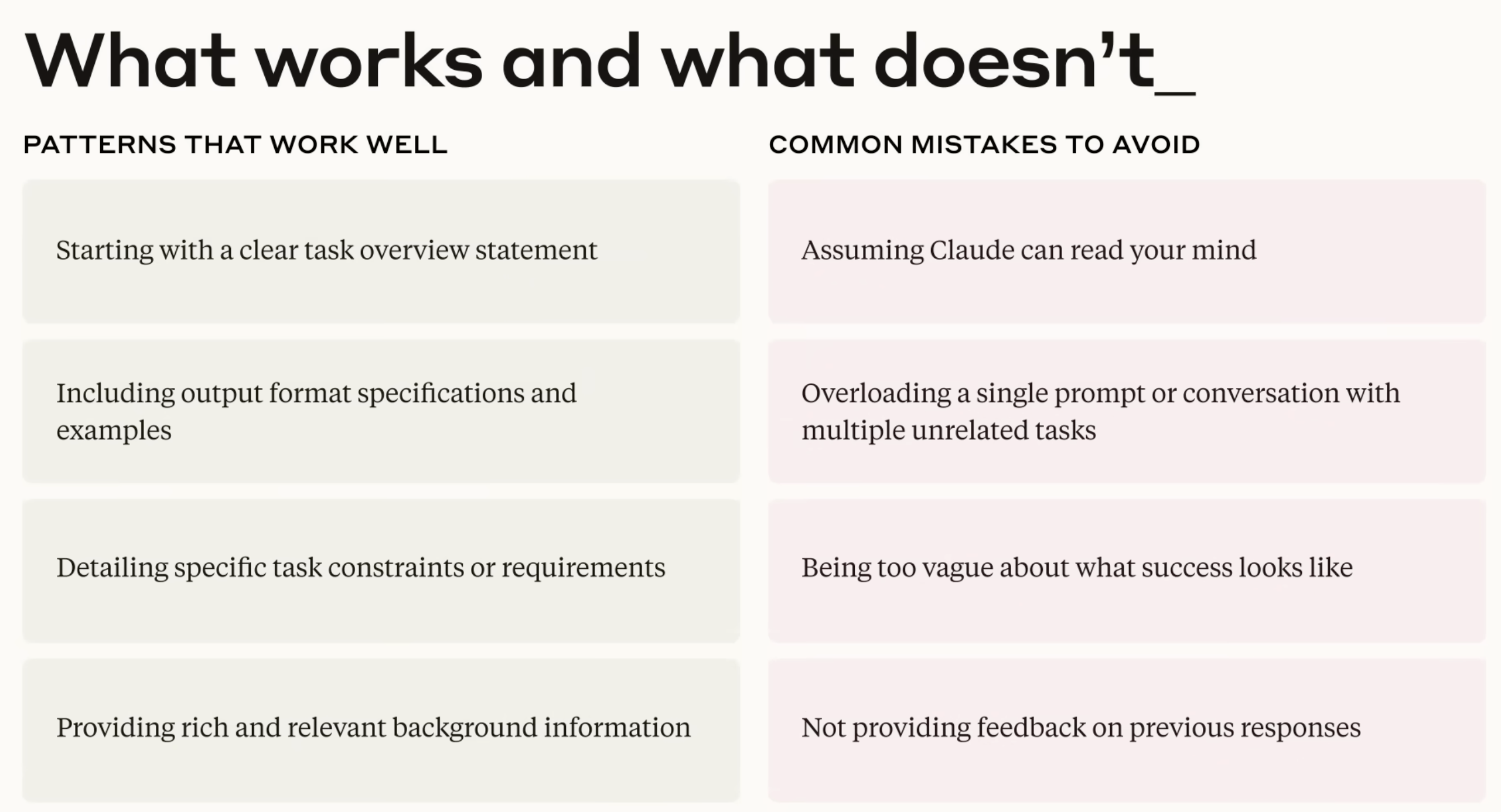
- Common successful patterns include clear task overviews, format specs, explicit constraints, and relevant background information
Effective Prompting techniques
- What we want
- How we want it done
- How we want to interact with the AI
Provide context
- Vague: "Tell me about climate change."
- Specific: "Explain three major impacts of climate change on agriculture in tropical regions, with examples from the past decade."
- Most specific: "Explain three major impacts of climate change on agriculture in tropical regions, with examples from the past decade. I'm preparing for a job interview at an agricultural research lab in Indonesia. I have a degree in ecology but no specific knowledge on climate change. Write a summary of key concepts that would help me speak intelligently in the interview."
Offer examples of what “good” looks like
- No examples: "Please convert this technical statement to plain language: 'The platform implements end-to-end encryption protocols to safeguard data integrity.'"
- With two examples:
- Original: "The quantum algorithm exhibits quadratic speedup."
- Plain: "The new method solves problems roughly twice as fast as previous methods."
- Original: "The interface leverages intuitive design paradigms."
- Plain: "The design is easy to understand and use."
- Now, convert this statement to plain language: "The platform implements end-to-end encryption protocols to safeguard data integrity."
- Original: "The quantum algorithm exhibits quadratic speedup."
Specify output constraints
- Without output specification: "Design me a personal art portfolio website."
- With output specification: "Create a clean, modern single-page portfolio website design with smooth scrolling between sections. Include these main sections: Hero, About Me, Skills, Portfolio/Projects, Experience, and Contact. Make the navigation menu sticky and responsive, with hamburger menu on mobile. Use a sunset color palette and add a dark / light mode toggle in the navigation."
Break complex tasks into steps
- No steps: "Analyze this quarterly sales data."
- With steps: "I'd like to analyze this quarterly sales data. Please approach this by:
- Looking through our sales records to identify the top-performing products
- Comparing current quarter results to the previous quarter
- Highlighting any unusual patterns or trends
- Suggesting possible reasons for these trends"
Define role, style, or tone
- For explanations: "Please explain how rainbows form from the perspective of an experienced science teacher speaking to a bright 10-year-old who's interested in science."
- For brainstorming & feedback: "As a UX design expert, review this website wireframe and suggest three improvements focusing on user navigation and accessibility."
Other Techniques to try
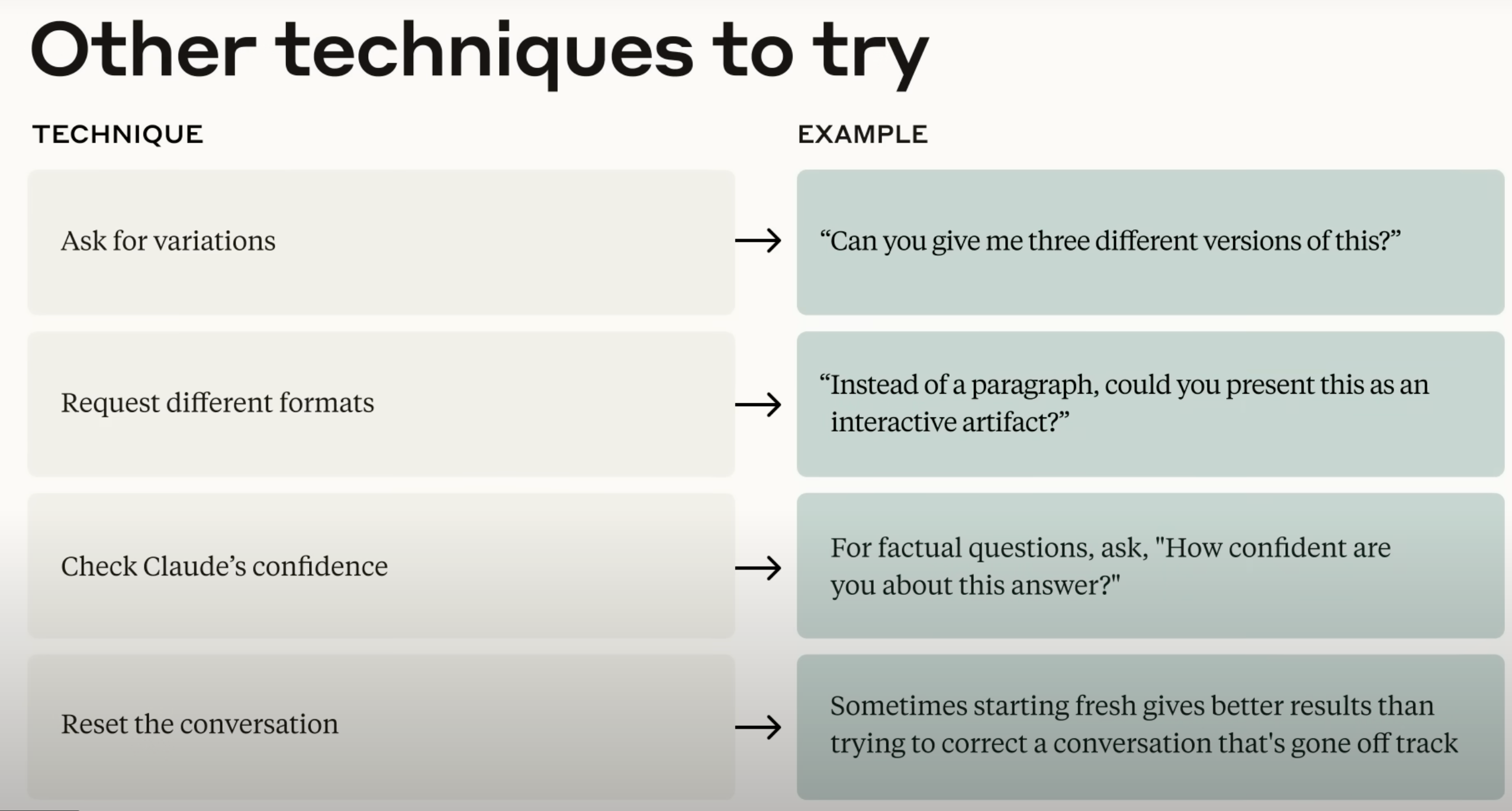
What works and what doesn't work
✍️
6 techniques for effective prompt engineering
See how vague prompts can be transformed into effective ones with these real-world examples.
Download